Digital intelligent construction cluster technology enables coordinated equipment operation by pre-entering process parameters. Combined with 3D road technology and a laser profiler, it precisely controls compaction speed and number of passes, detects millimeter-level fluctuations, and promptly recompacts. This improves both construction efficiency and smoothness, eliminates manual operation risks, and ensures uniform and stable paving across the entire width.
Bridge Construction Scenarios
01. Bridge construction requires extremely high smoothness and compaction levels, making deviations more likely to occur during paving of wide bridge decks.
Digital intelligent construction cluster technology pre-enters process parameters to enable coordinated equipment operation. Combined with 3D road technology and laser profilers, it precisely controls compaction speed and number of passes, detects millimeter-level fluctuations, and promptly recompacts. This improves both construction efficiency and smoothness, eliminates manual operation risks, and ensures uniform and stable paving across the entire width.
02. The asphalt mixture on bridge decks cools rapidly, and temperature fluctuations can easily lead to unstable compaction quality and affect pavement durability.
The road construction temperature field scanning system uses drone infrared cameras to generate a temperature field. The digital construction system collects temperature data in real time, guiding the roller to the optimal compaction range. This significantly improves compaction efficiency and smoothness, ensuring the strength and durability of the asphalt pavement and reducing subsequent maintenance costs.
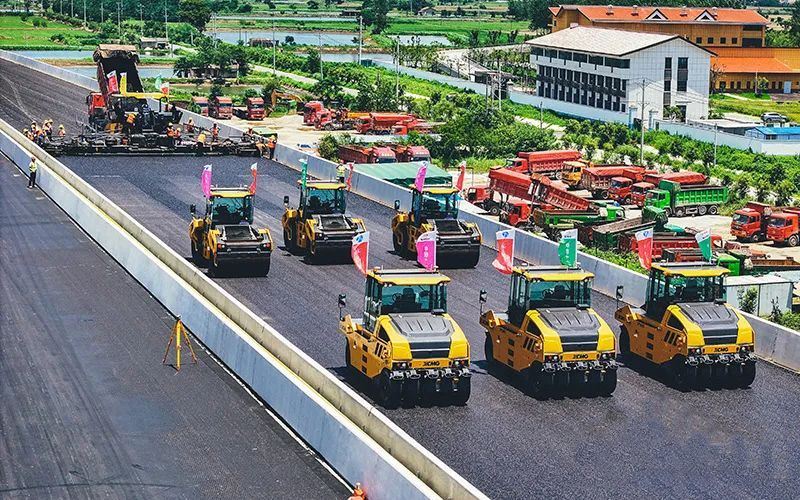
XCMG's one paver and seven unmanned rollers completed paving for 33.61 kilometers of the main line. Smart construction technology utilizes an intelligent platform to sense demand and adjust rolling parameters. Even with bridge deck temperatures reaching 50 degrees Celsius, the equipment continued to operate 24 hours a day, achieving a 25% improvement in efficiency compared to traditional processes and eliminating the need for operators to face high temperatures. The project's chief engineer praised the project's exceptional quality, efficiency, and safety, demonstrating the strength of XCMG's smart construction capabilities.
Tunnel Construction Scenario
01. Satellite signals are blocked in tunnels, making it difficult for traditional equipment to lose their position and recover, impacting construction continuity.
SLAM laser hybrid navigation technology eliminates reliance on satellite signals. Through real-time laser modeling and autonomous positioning, combined with cluster control technology, it enables precise equipment coordination. This ensures uninterrupted construction, reduces delays caused by positioning issues, and improves construction stability.
02. Sites like immersed tube tunnels and undersea tunnels have complex geology, and traditional compaction can easily damage sensitive structures.
Oscillating compaction technology achieves rapid compaction of asphalt mixtures. Alternating oscillating forces and high-frequency shearing eliminate porosity in the mixture, creating a highly durable pavement and reducing subsequent maintenance costs.
03. Tunnel space is narrow, with numerous equipment and concentrated work surfaces. Traditional manual scheduling leads to chaotic processes and low efficiency.
IoT and big data technologies build an intelligent scheduling platform that monitors equipment status in real time and rapidly allocates resources. Combined with radar surveys and BeiDou positioning, it enables automated construction route planning. This reduces equipment idleness, shortens project cycles, and reduces manual scheduling costs.
04. Harsh tunnel environments (such as poor ventilation and dim lighting) pose a significant threat to the health and safety of construction workers.
Low-latency, high-bandwidth remote control technology, combined with high-definition imagery, enables drivers to safely control equipment remotely. This reduces the frequency of personnel entering high-risk areas, mitigates the risk of safety incidents, and ensures operational efficiency.


